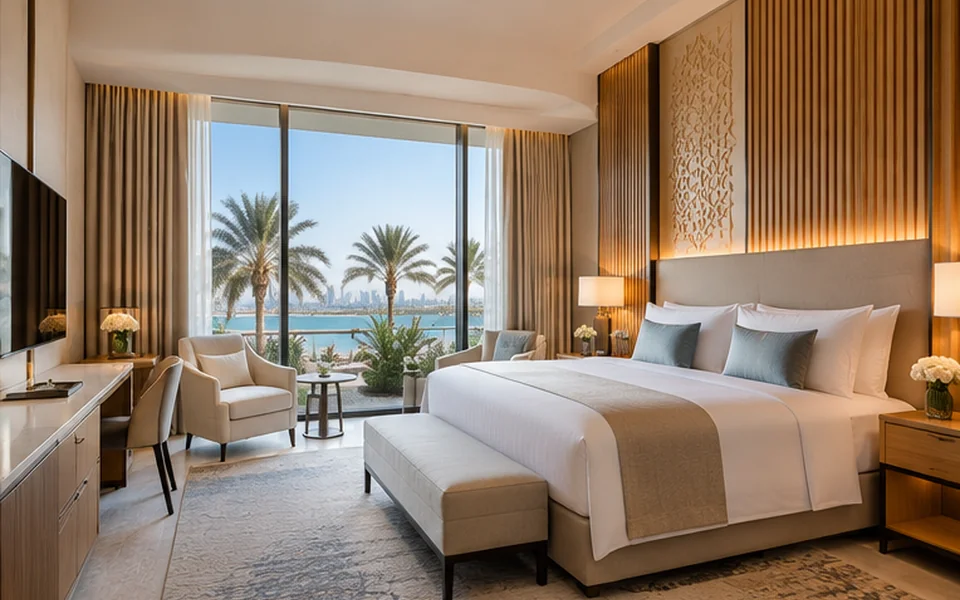
A hotel interior design company in Hong Kong faces a familiar challenge: guests expect comfort even when rooms are relatively compact. The solution is careful prioritisation rather than squeezing in every possible feature. A guestroom should support luggage, sleep, work and daily routines while remaining straightforward for housekeeping to maintain.
Balance guest comfort, storage, lighting, maintenance and housekeeping within compact hotel guestrooms.
Plan around the guest journey
Test entering with luggage, hanging clothes, charging devices, working and reaching the bathroom at night. Door and furniture clearances are critical when space is limited. A generous visual feature may be less valuable than a reliable bedside socket or convenient luggage bench. Mock-ups reveal conflicts before repeated rooms are built.
Make lighting intuitive
Provide separate controls for general light, reading and nighttime movement. Check glare at a desk and reflective surfaces near the bed. Guests should not need an instruction manual to switch off all lights. Evaluate lighting in both day and night scenarios, with the actual furniture and bedding samples.
Consider maintenance and housekeeping
Choose finishes that tolerate regular cleaning and allow parts to be replaced without extensive demolition. Accessible service panels, robust hardware and protected corners reduce long-term disruption. Coordinate with the operator on housekeeping routines and acceptable replacement downtime. Details that are hard to maintain eventually affect the experience of every guest.
Review accessibility and comfort options
Different room types may have different user requirements. Relevant accessibility, fire safety and building constraints require professional coordination. Do not infer compliance from a stylish rendering. Mock-up testing can include different luggage sizes, heights and mobility needs while preserving a coherent room identity.
Example: a practical project decision
A hotel bedroom concept looks elegant in renderings but leaves no place to open a suitcase. Testing a full-size sample room results in a narrower desk and a more useful luggage surface.
Putting this into practice
At the next review, ask the project team to test an actual suitcase and furniture clearances. The following discussion should address how to check lighting controls while lying in bed. Document the assumptions, responsible people and any unresolved questions before approving drawings or supplier orders. Before the next commitment, review housekeeping and repair access and mock up a representative guestroom. Where building management instructions, technical submissions or specialist work are involved, seek the advice of properly qualified parties. A useful decision record explains not only what was chosen but why, with any effect on budget, maintenance, user comfort or construction programme clearly stated.
A short decision checklist
- Test an actual suitcase and furniture clearances
- Check lighting controls while lying in bed
- Review housekeeping and repair access
- Mock up a representative guestroom
Frequently asked questions
Are space-saving furniture pieces always useful?
Only when they remain comfortable, durable and intuitive for a wide range of guests.
Why build a sample guestroom?
It reveals dimensional, operational and maintenance issues before repeating them across many rooms.